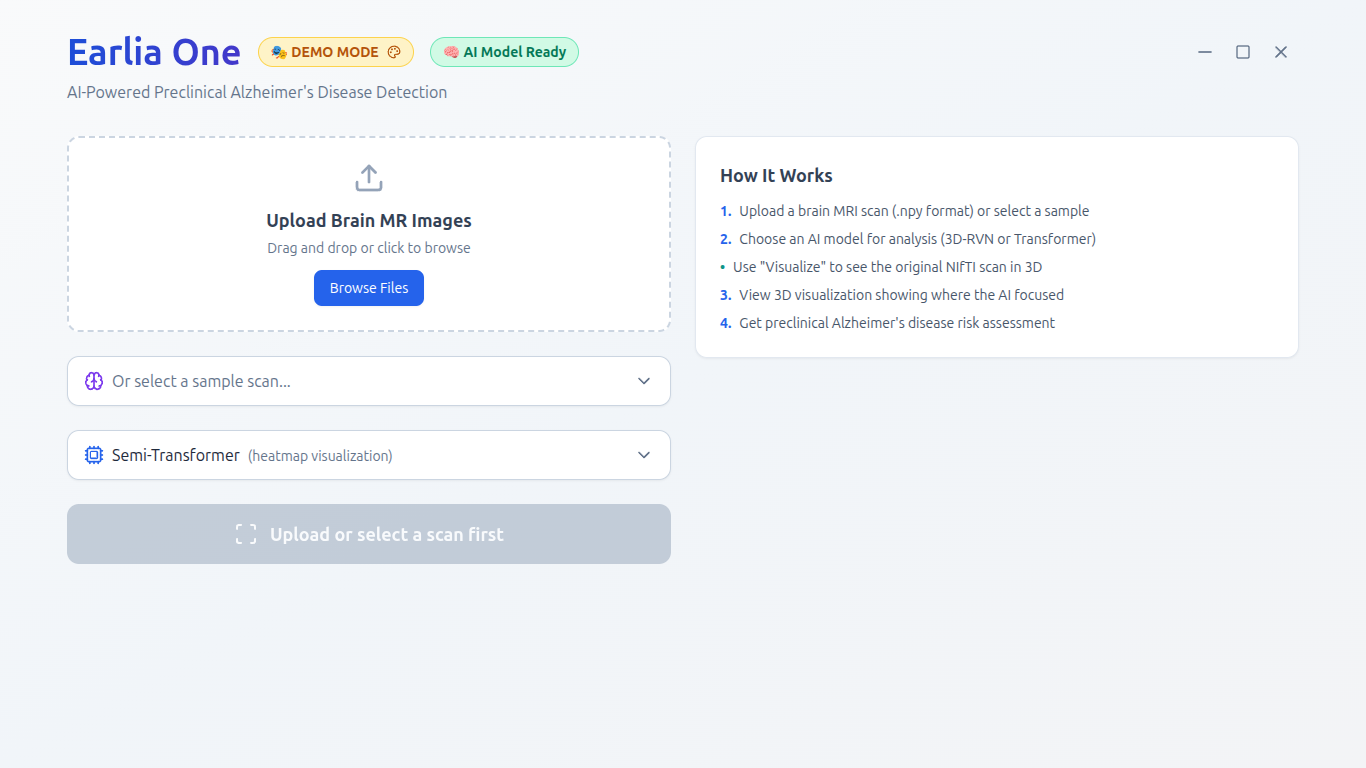
Privacy-preserving, explainable desktop workflow for brain MRI. Run preclinical Alzheimer's risk analysis locally, inspect attention overlays in 3D, and export a reviewable PDF report.
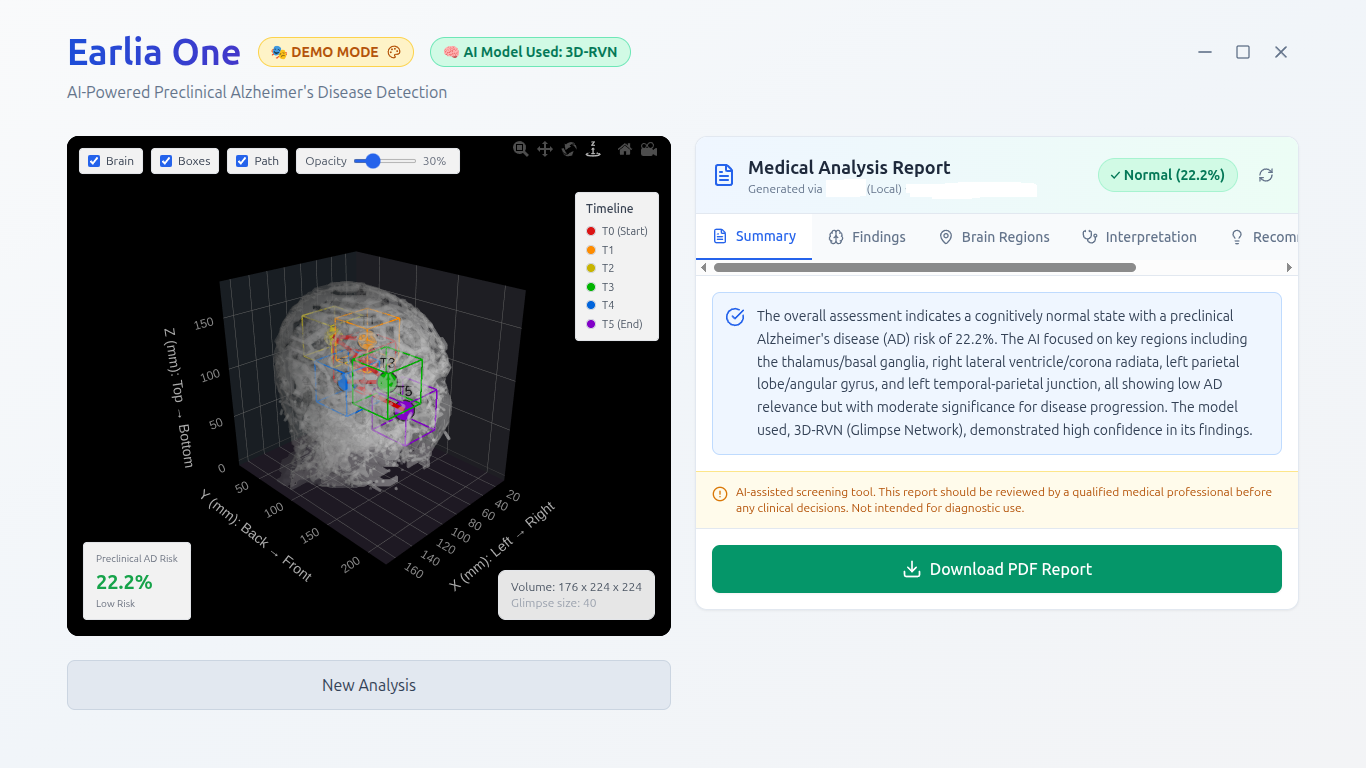
3D visualization, explainable attention maps, and full transparency into every AI prediction.
Visualize 3D brain MRI in an interactive viewer. Rotate, zoom, and inspect from any angle.
See exactly which brain regions the model focused on with interactive 3D attention overlays.
All inference runs locally. Patient data stays on your machine / inside your network (deployment-dependent).
Generate PDF reports with model outputs, confidence scores, and attention snapshots — plus an LLM-generated draft narrative for clinician review.
Maximum speed inference on your existing hardware.
Multiple model architectures available, with more on the roadmap.
Three simple steps. No cloud. No complexity. Just answers.
Drag and drop a brain MRI file, or select from sample scans.
Inspect the 3D brain and click Analyze to run local inference (3D-RVN baseline or Semi-Transformer).
Inspect attention regions, review scores, and export a PDF report with visual evidence for review.
No browser tabs, no account creation, no learning curve.
Runs on Windows, macOS and Ubuntu. Single-click install.
Clean light theme for clinical settings, dark theme for reading rooms.
Model outputs, attention maps, and a clinician-reviewable draft narrative — exported as PDF.
Choose between two preclinical Alzheimer's models: 3D-RVN (baseline) and Semi-Transformer (higher accuracy).
Earlia One began as peer-reviewed research showing that subtle neuroanatomical patterns in 3D brain MRI—well before clinical symptoms—can be used to estimate preclinical Alzheimer's risk.
Visualize, analyze, and export reports — all on your own infrastructure.